India has over 900,000 retail pharmacies. Most of them still run on manual processes, handwritten registers, or basic billing software that has not changed in a decade. Meanwhile, AI is quietly rewriting the rules of how pharmacies operate -- from how invoices are entered to how expiry is tracked and how business decisions are made. Here is what that shift looks like on the ground, and why it matters for every pharmacist in India.
The State of Pharmacy Operations in India
The Indian pharmaceutical retail market is worth over Rs 2.5 lakh crore and growing at roughly 10% annually. Yet the operational infrastructure behind most pharmacies tells a different story. Walk into a typical chemist shop in any Indian city or town, and you will find a familiar scene: stacks of paper invoices from distributors, a register for tracking expiry dates, and a billing computer running software that was designed 15 years ago.
The challenges are well known to anyone who runs a pharmacy:
- Invoice entry is painfully slow. Each distributor invoice has 30 to 100 line items. Typing them manually takes 20 to 40 minutes per invoice. A pharmacy receiving 5 to 10 invoices daily spends 2 to 4 hours just on data entry.
- Errors compound silently. A wrong batch number, a mistyped MRP, or a missed expiry date does not cause immediate problems. It surfaces weeks or months later as a compliance issue, a customer complaint, or expired stock on the shelf.
- Expiry tracking is reactive, not proactive. Most pharmacists check shelves manually or run reports only when they remember to. By then, medicines may have already expired or the return window with the distributor has closed.
- Business decisions are based on gut feeling. Which medicines are your most profitable? Which distributor gives you the best margins? Which products are sitting idle? Without real analytics, these questions go unanswered.
This is the gap that AI is filling -- not with science fiction, but with practical, accessible tools that solve real problems pharmacists face every day.
What AI Means for Pharmacy Operations
When pharmacists hear "artificial intelligence," many picture robots or complex systems that require technical expertise. The reality is far more practical. AI in pharmacy management means software that can see, read, learn, and predict -- handling tasks that currently eat up hours of human effort.
Consider what happens when you scan an invoice with your phone camera. Traditional OCR (Optical Character Recognition) can read printed text, but it struggles with the messy reality of Indian pharmaceutical invoices -- different formats from every distributor, varying layouts, handwritten notes in the margins, and faded thermal prints. AI-powered OCR goes further. It understands the structure of an invoice. It knows that the column after the medicine name is likely the batch number, that "Exp" followed by a date is the expiry, and that the number next to "MRP" is the maximum retail price.
This kind of contextual understanding is what separates AI from basic automation. The software does not just follow rigid rules. It interprets data the way an experienced pharmacist would, but faster and without fatigue. And critically, it gets better over time. The more invoices it processes from a particular distributor format, the more accurate it becomes.
For Indian pharmacies specifically, this matters because of the sheer diversity of invoice formats in the market. There is no single standard. Every distributor prints invoices differently. AI handles this variation in a way that rule-based software simply cannot.
5 Ways AI is Changing Pharmacy Management
1. Intelligent Invoice Scanning
This is where AI makes its most immediate, visible impact. Instead of manually typing each line item from a distributor invoice, you take a photo. The AI extracts medicine names, quantities, batch numbers, expiry dates, MRP, purchase price, GST details, and discount information -- all in seconds.
What makes modern AI scanning different from basic OCR is accuracy on real-world invoices. Indian pharmaceutical invoices are notoriously inconsistent. Medicine names are often abbreviated differently by different distributors. The same drug might appear as "Tab Azithromycin 500mg," "AZITHRO 500 TAB," or "Azithral-500." AI models trained on Indian pharmacy data recognize these variations and map them correctly to your inventory.
The practical result: invoice entry that used to take 30 minutes now takes 2 minutes. The pharmacist reviews the extracted data, makes corrections if needed, and confirms. Inventory is updated instantly with accurate batch and expiry information.
2. Predictive Inventory Management
Traditional pharmacy software can tell you what you have in stock right now. AI goes a step further by analysing your sales patterns to predict what you will need next week, next month, or next season.
This is not theoretical. Pharmacies see clear seasonal patterns -- antihistamines peak during allergy season, antacids sell more during festival periods, and cold medicines surge in winter. AI identifies these patterns from your own sales data and can flag when you are likely to run out of a fast-moving product or when you are overstocked on something that is about to slow down.
For a pharmacist managing 3,000 to 10,000 SKUs, this kind of automated intelligence is not a luxury. It is the difference between profitable inventory turns and cash locked up in dead stock.
3. Proactive Expiry Management
Expired medicine is one of the biggest sources of loss for Indian pharmacies. Industry estimates suggest that 2% to 5% of pharmacy inventory expires on the shelf -- that translates to lakhs of rupees in losses annually for a medium-sized pharmacy.
AI-powered expiry management does more than just show you a list of soon-to-expire medicines. It prioritizes which items to act on based on the return policies of your distributors, the remaining shelf life, and the likelihood of selling through the stock before expiry. It can alert you 90, 60, or 30 days before expiry and suggest whether to push sales, arrange returns, or offer discounts to move the stock.
When every batch is tracked digitally from the moment the invoice is scanned, nothing slips through the cracks. There is no relying on someone remembering to check the shelf. The system knows exactly what is where and when it expires.
4. Customer Insights and Purchase Patterns
Every billing transaction contains information about your customers' needs. AI can aggregate this data to reveal patterns that are invisible in day-to-day operations. Which customers buy chronic medication regularly? Who has not come in for their usual refill? What products are frequently purchased together?
These insights help pharmacies provide better service. A pharmacist who knows that a regular customer is due for a blood pressure medication refill can proactively keep stock or even send a reminder. This is not about replacing the personal relationship between a pharmacist and their customers. It is about strengthening it with better information.
For pharmacies looking to grow, customer purchase data also reveals opportunities. If multiple customers ask for a product you do not stock, that is a signal. If a particular category is growing month over month, that informs your purchasing decisions.
5. Smart Billing and Margin Tracking
AI-powered billing goes beyond generating invoices. It tracks your margins in real time -- not just overall, but per product, per category, and per distributor. When you know that Distributor A gives you 22% margin on a product while Distributor B gives 18%, you make better purchasing decisions.
Smart billing systems also handle the complexity of Indian pharmaceutical pricing: MRP-based selling, various discount structures, GST calculations with correct HSN codes, and the split between CGST and SGST. AI ensures accuracy across all of this, reducing billing errors and the time spent reconciling at the end of each day.
Margin analytics, in particular, is something most pharmacists track poorly or not at all. When the software automatically calculates your effective margin on every purchase -- accounting for trade discounts, cash discounts, and GST -- you finally see the true profitability of your business.
Real Impact: Numbers That Matter
The benefits of AI pharmacy management are not abstract. They show up in measurable improvements that directly affect a pharmacy's bottom line and daily operations.
Consider what 2 to 3 hours saved per day means over a year. That is roughly 700 to 1,000 hours -- time that a pharmacist can spend on customer service, expanding their product range, or simply going home earlier. The financial impact of reduced expiry losses alone often justifies the cost of modern pharmacy software within the first few months.
Error reduction deserves special attention. A single wrong batch number entry might seem trivial, but it cascades: incorrect stock counts, failed drug traceability, compliance risks during inspections, and potential patient safety issues. AI eliminates the root cause by capturing data directly from the source document.
AI vs Traditional Pharmacy Software
The differences between AI-powered pharmacy management and traditional software are not just incremental improvements. They represent a fundamentally different approach to how a pharmacy operates.
| Capability | Traditional Software | AI-Powered Software |
|---|---|---|
| Invoice Entry | Manual typing, 20-40 min per invoice | Photo scan, 2 min per invoice |
| Batch Tracking | Manual entry, error-prone | Auto-extracted from invoice image |
| Expiry Alerts | Basic reports, run manually | Proactive alerts with action suggestions |
| Inventory Insights | Current stock levels only | Predictive demand, trend analysis |
| Medicine Name Matching | Exact match or manual search | Fuzzy matching across abbreviations |
| Margin Analysis | Basic or absent | Per-product, per-distributor, real-time |
| Learning Over Time | Static rules, no adaptation | Improves accuracy with usage |
| Setup Effort | Days to weeks, data migration | Minutes, start scanning immediately |
The most significant difference is not any single feature -- it is the shift from reactive to proactive operations. Traditional software records what happened. AI-powered software helps you decide what to do next.
Getting Started with AI Pharmacy Software
Switching to AI-powered pharmacy management does not require technical expertise, expensive hardware, or weeks of setup. Here is a practical path for any pharmacy looking to make the transition.
Step 1: Assess Your Current Pain Points
Before adopting any new tool, identify what costs you the most time and money. For most pharmacies, the answer is invoice entry, expiry tracking, or lack of business visibility. Knowing your priorities helps you evaluate software against your actual needs rather than feature lists.
Step 2: Start with Invoice Scanning
The fastest way to see the value of AI is to scan your next distributor invoice instead of typing it. MedLens lets you do this from day one -- take a photo of your invoice, review the extracted data, and confirm. Your inventory is updated with accurate batch and expiry information. No need to migrate your entire operation at once.
Step 3: Build Your Digital Inventory Gradually
Every invoice you scan adds products to your digital inventory with correct batch and expiry data. Within a few weeks of regular use, you have a comprehensive, accurate picture of your stock -- built naturally through your daily operations rather than through a painful bulk data entry exercise.
Step 4: Use Analytics to Make Better Decisions
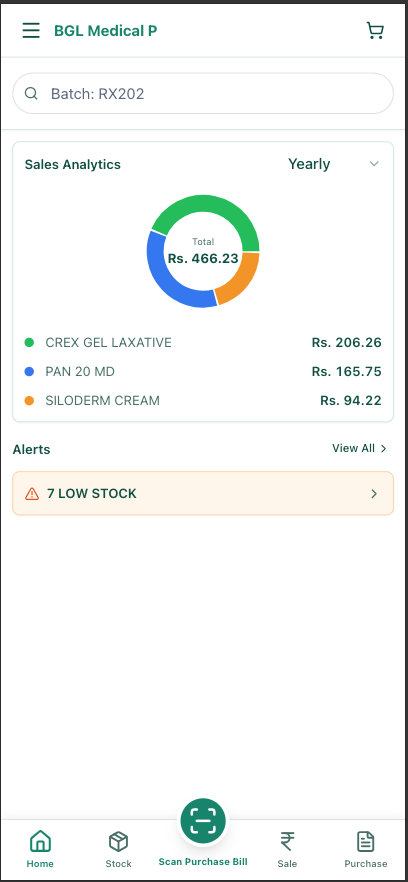
Once you have a few weeks of data, the analytics start becoming useful. You can see which products are selling fast, where your margins are strongest, and which items need attention before they expire. This is where AI pharmacy management transitions from a time-saving tool to a business growth tool.
What You Need to Get Started
- A smartphone with a camera (Android or iOS)
- An internet connection
- 10 minutes for initial setup
There is no special hardware to buy, no barcode scanner required for invoice entry, and no lengthy training period. If you can take a photo with your phone, you can use AI pharmacy software.
The Future of AI in Indian Pharmacies
The current generation of AI pharmacy tools addresses the most pressing operational problems -- data entry, accuracy, and basic analytics. But the trajectory points toward much deeper integration of AI into every aspect of pharmacy operations.
Automated Reordering
AI systems that understand your sales velocity, seasonal patterns, and distributor lead times will be able to generate purchase orders automatically. The pharmacist reviews and approves, but the analysis and recommendation happen without manual intervention. This reduces stockouts on fast-moving items and prevents over-ordering of slow movers.
Drug Interaction Awareness
As pharmacy software accumulates patient purchase history (with appropriate consent), AI can flag potential drug interactions at the point of sale. A pharmacist dispensing a new prescription can be alerted if it conflicts with something the customer purchased recently. This is an area where AI adds genuine patient safety value.
Regulatory Compliance Automation
India's pharmaceutical regulations are becoming stricter, with increasing requirements around drug traceability, record keeping, and reporting. AI can automate compliance reporting, maintain audit trails, and ensure that every transaction is documented correctly -- reducing the burden on pharmacists during inspections.
Multi-Store Management
For pharmacy chains and owners with multiple outlets, AI enables intelligent stock transfer between locations. If one store is overstocked on a product that another store needs, the system can suggest transfers. Consolidated analytics across stores give owners a complete picture of their business.
Voice and Vernacular Interfaces
One of the most promising developments for Indian pharmacies is AI that works in local languages. Not every pharmacist or pharmacy assistant is comfortable with English-language software. Voice-enabled interfaces and vernacular support will make AI pharmacy tools accessible to a much wider base of users across India.
The pharmacies that adopt AI tools early will have a structural advantage -- not just in efficiency, but in the depth of business intelligence they accumulate over time. A pharmacy with two years of AI-analysed sales data makes fundamentally better decisions than one still relying on memory and instinct.
The transition does not need to happen overnight. It starts with scanning your first invoice instead of typing it. Every day after that, the system gets a little smarter, your inventory gets a little more accurate, and your understanding of your business gets a little deeper. That compounding effect is what makes AI in pharmacy management not just useful, but transformative.
Start Managing Your Pharmacy with AI
No credit card required. Set up in under 10 minutes. Scan your first invoice today.
Try MedLens FreeMedLens is built specifically for Indian pharmacies, with AI trained on Indian pharmaceutical invoice formats, full GST compliance, batch-level tracking, and support for pharmacies of all sizes.